Wednesday, 15 October 2008

Free Enterprise Search Focus Group on Thursday 23rd October

Next Thursday, IPP Consulting will be hosting a free Enterprise Search Focus Group to look at the challenges of implementing Web-like search inside organisations.

That’s the requirement that comes up all the time – give me a “Google-like search capability”… but why is it so hard?

This focus group follows the success of our mini KM Bootcamp last month and was inspired by the response to this post the other week.

To explore this topic we will discuss:

  • What is enterprise search?
  • The mechanics of Enterprise Search vs Web search; and
  • Gathering requirements and planning for Enterprise Search.

We will also have a basic Enterprise Search engine up and running to demonstrate and explore some of the issues covered during the focus group.

This will be a great vendor-free forum to ask questions about implementing Enterprise Search.

Date: Thursday 23rd October 2008

Time: 8.45am for a 9am start. Finishing at 11.30am.

Where: IPP Consulting, L3, 50 Pitt Street, Sydney 2000

RSVPs: Places are limited - please give me a call on 02 9247 6811 (office) or 0414 2333711 (mobile) if you would like to attend.

PS Not interested in Enterprise Search? Feel free to suggest a topic you would like to see covered in the future!

Extending intranets to hard-to-reach staff: Controlled documents kiosk example

This Intranet Benchmarking Forum (IBF) post about meeting the needs of hard-to-reach staff reminded me of a kiosk system that was developed on top of an electronic document and records management system at Illawarra Coal (part of BHPB Billiton) – I was part of the team that helped to implement the system and came up with the conceptual design of the intranet publishing architecture from this system.

Quoting from an Illawarra Coal community newsletter (PDF) from last year, this is an overview:

Dendrobium first to trial new computer technology

Illawarra Coal has maximised its commitment to keeping its employees safe and informed with the launch of new computer technology which potentially offers all of its employees – even those who do not work at or have access to a regular computer terminal – 24 hour a day access to controlled documents.

Dendrobium mine is the first to trial the iPICK(Information Point, Illawarra Coal Kiosk) technology, with management, contractors and employees enjoying improved access to information and reduced complexity. Developed by Illawarra Coal in partnership with local software company iQmultimedia –iPICK provides the workforce uninhibited access to controlled documents such as emergency procedures, management plans, work instructions and so on.  The specially developed touch-screen kiosk in operation at Dendrobium means that while the information can now be accessed via the intranet of Illawarra Coal, employees don’t need to have access to a PC to get the information they need.

I understand that the system – which uses a standard Web browser is gradually being extended to provide access to other useful Web-based systems.

The IBF list the following examples of hard-to-reach staff:

  • factory workers
  • retail staff
  • field engineers
  • building inspectors
  • consultants
  • sales teams
  • flight and rail workers
  • catering staff
  • building inspectors
  • call centre representatives
  • insurance assessors.

Clearly in many industries, extending the intranet beyond the office environment can add tremendous value. And in some cases it can even protect people from injury and other physical risks – which is the kind of value you can’t put a price on.

BTW I would also add to this list external partner and suppliers – extending to the intranet as an extranet can also add value too.

The Comments Have It

You might recall there was a brief flurry of discussion about the value of commenting in blogs. I noticed that ProBlogger, Darren Rowse, kicked off a discussion on the same topic. Rowse himself doesn’t add a lot of value to the discussion, but the comments on this topic make interesting reading.

For the most part, the people reading Rowse’ blog maintain that comments are important, although no one likes comment spam. For example, someone responds:

I think turning comments off is snobbish and rarely read the blogs that don’t have comments. It seems selfish to me. It makes it seem like they don’t give a crap about what you think on what they wrote which, in my opinion, means that there would be no point in writing…….

But there are some exceptions and Seth Godin is cited as example – he explained back in 2006 why he switched off comments:

First, I feel compelled to clarify or to answer every objection or to point out every flaw in reasoning. Second, it takes way too much of my time to even think about them, never mind curate them. And finally, and most important for you, it permanently changes the way I write.

However, a few people feel that Godin is blogging AT them, rather than talking with them. IMHO none of this detracts from Godin’s success and there is nothing wrong with using a blogging tool as a publishing platform. But as a social media tool, a blog needs to be, well, social…

Ok. Back to you. The comment button is below!

Tuesday, 14 October 2008

Tips for Twitter Newbies

There is a really smart list of newbie Twitter tips from @silkcharm.

The one thing I’d add is that I think some people make the mistake of just looking at the Twitter website and wondering what’s the point. The trick of course is to integrate one or more Twitter apps into your personal information workspace, which makes it so much easier to follow and participate in the flow.

Personally, I use twhirl and also have a Twitter app on my mobile phone, which I only use occasionally.

Technorati Tags: ,,

If Enterprise 2.0 software gets cheaper, will they invest more in the people issues?

ReadWriteWeb provides a summary of a new report from Forrester that predicts changes in the pricing of Enteprise 2.0 software tools:

the market for collaboration and productivity web apps in the enterprise (a.k.a. enterprise 2.0) is set for a shake-up, with prices to fall in some cases by over half. Price drops will be especially sharp in blog, wikis, social networking and widgets. The only exception is mashups, which will increase in price over the next 5 years.

Forrester says the price drops will be due to "cutthroat competition, commoditization, bundling, and subsumption", with many startups and established big companies competing for the enterprise dollar.

There is still expected to be strong adoption by enterprises of web 2.0 apps, which will result in increased license revenue. However that will be offset by the large price drops.

However, I’m particularly pleased to see that Forrester (quoted by RWW) say that Enterprise RSS will play "a critical role as the Web 2.0 middleware, staving off major price declines." compared to other Enterprise 2.0 tools.

I do also hope that if companies are able to spend less on the software they install then they will be able to invest more in the implementation.

Friday, 10 October 2008

This week – David Gurteen, 3eep and talking Web 2.0 with accountants

Aside from seeing my new Intranet 2.0 article in print, this week has been interesting for a couple of reasons.

I’ve spent most of today with David Gurteen, who started the day by presenting and then running one of his famous Knowledge Cafe sessions for the NSW KM Forum. I had the chance, along with a couple of others from the KM Forum, to talk more informally with him over lunch and then we finished the day with a one-on-one chat I managed to arrange between David and someone with a particular interest in the Knowledge Cafe process. I’ve used the cafe approach a few times myself and like it – but its always interesting to listen to someone like David who has using the technique all around the world. Its also a good reminder of how KM can work without technology and how an apparently simply KM process can have a powerful effect.

In between David, I also had the chance to chat with Nick Gonios about 3eep (pronounced “threep”) and their latest development, SportsPassion. Considering I normally spend my time talking to companies and organisations about knowledge and information issues inside the firewall, it was interesting to hear about a company that is focused on supporting the social networking needs of another fundamental human endeavour – sport! What impressed me about Nick was that he clearly has a good appreciation of both the technology and social aspects of what he is trying to achieve. Anyway, if you’re in a sports team of any kind, check it out.

Finally, back on Wednesday night I had the chance to present to a National Institute of Accountants professional development group in Burwood about Web 2.0. I had a very warm welcome and they were interested to learn, engage and even challenge some of the trends. However, bearing in mind the age of my audience, it was also a good reminder for me that many aspects of Web 2.0 still aren’t common knowledge across the whole of the community. For example, most people have heard of Facebook but have limited exposure to anything else. Also, one of the key concerns was people saying they don’t have time to engage with social media…. and I think there is a point that you shouldn’t be adding to your information workload with social computing, but replacing and improving existing work practices. However, I think that maybe the old 9X challenge is also at work here?

Looking for Intranet 2.0

If you are an Image & Data Manager magazine (IDM) subscriber, my latest article (PDF) that looks at the three alternative Intranet 2.0 strategies, titled Too cool for school, is now out in print in the September/October 2008 edition.

This article was based on many of the ideas I put forward in a workshop I ran last year on Intranet 2.0 and its worth reading the article and browsing the slides at the same time (just so you don’t get confused, I was still with CSC at that time, hence the CSC branding on the title slide):

Note: You can now download a copy of the article (PDF) As always I’ll make a copy of this article online in due course (my last IDM article and another new whitepaper is already available for download).

Unfortunately, due to space, one part of the article didn’t quite make the cut – however, as its also something I didn’t address in my original workshop I thought I would share it here anyway.

The context is that in the article (and also the workshop) I outline three broad Intranet 2.0 strategies (tactical social computing, a Web 2.0 orientated intranet and Enterprise 2.0). However, if none of those approaches fit your organisation’s vision for Intranet 2.0 then you might like to consider alternative and complimentary pathways for breaking out of the traditional intranet model. These include some revolutionary and not so revolutionary ideas, which are:

  • Metaverses – ‘3D world’ (or ‘metaverse’) technologies such as ‘OpenSim’ (an open source version of Second Life) and Sun’s ‘Project Wonderland’ allow organisations to securely host these environments internally and represent a complete departure from the traditional concept of the intranet and how users interact with it;
  • Social networking sites as intranets – Software company Serena has championed the idea of using social networking sites like Facebook as a replacement for the traditional company intranet – or if you prefer, you can setup an internal social and skills-sharing network instead;
  • Combine into a single extranet – Many organisations still operate separate intranet and Internet sites, but mature portal and newer wiki technologies already exist to make this kind of symbiotic combination a reality;
  • Support for mobility and other points of access – Most intranets are designed for full size computer users, but alternative access channels such as mobile computing and kiosks can be supported; and
  • Unified collaboration – The next evolution of the Unified Communication concept, brings same time interaction into the context of content, business process and business activities.

I must admit that out of all those suggestions I’m less excited about Serena’s idea of using Facebook as an intranet, however there is no doubt there is huge potential for improving our ability to find other people in organisations through enterprise social networking technologies. Also, I’m not sure if enterprise microblogging (e.g. Yammer) can sit neatly with Unified Collaboration in this list of ideas, but its clearly another possible option for injecting a little bit of Intranet 2.0 into your existing intranet.

Want to know more about Intranet 2.0? Then give me call, a tweet or an email. I’m always more than happy to chat further over coffee or present something more formal.

BTW Later in the month I’ll be presenting again at Key Forum’s Intranet 2.0 conference, this time on Enhancing employee performance with real time content and personalisation. Hope to see you there!

Thursday, 2 October 2008

I want Google-like search in my company… well, you can’t have it!

I was reading a requirements document the other day and the old “we want Google-like search” raised it head again.

I’m not sure why we need to keep saying this, but it is generally accepted in the information management community that a Google-like search is neither desirable nor achievable in a complex enterprise environment.

Anyone that claims they can implement a Google-like search is setting unrealistic expectations (unless of course we’re talking about a very progressive Enterprise 2.0 organisation).

BTW This is a distinct argument from the questioning the suitability of Google’s search appliances – in my experience where I have seen them fail in practice its due to the implementation approach and an expectation of “plug and play”, rather than the technology itself.

Or am I wrong?

Wednesday, 1 October 2008

Out of the box: Supporting projects with a collaborative infrastructure pattern

I’ve joked before about SharePoint being the new Lotus Notes, but in all seriousness its great to see that a successful pattern from the past can still be applied to the new generation of Web-based collaboration platforms – most recently its the example of Transfield Service’s Team Sites in a Box.

I use the word *pattern* deliberately because this isn’t a formula approach – it needs to be tailored to the technology and business activities it supports. For example, I’ve seen a similar approach to Transfield’s concept applied to collaboration tools like eRoom, Quickplace and Lotus Notes in the past.

The Lotus Notes story is a good one tell because years ago at Ernst & Young in Australia I was involved in developing a series of internal “products” as part of the then Centre for Business Knowledge’s service offering – and one of these products was called Pursuit Team in a Box. :-)

However unlike Transfield, we bundled not only the technology and support (which was underpinned by the overarching EY/KnowledgeWeb architecture and governance model) but a range of information and knowledge management services, including competitive intelligence. The the types of support activities provided were also tailored to the size of the project. However, the overall pattern was the same.

A more generic model for this pattern – and one that I’ve used over and over again – is the concept of “Collaborative Infrastructure” – the following slides should give you an idea of how this works:

For further reading beyond my own articles and papers that refer to the Collaborative Infrastructure model, I suggest you check out Implementing Collaboration Technologies in Industry: Case Examples and Lessons Learned.

Socialtext’s evolution towards the “intranet”?

After commenting on ThoughtFarmer’s post about being a hybrid wiki/intranet CMS, I started reading about Socialtext latest version 3 release. It has some interesting new hybrid features, which are demonstrated in this short video:

One of the new features is the “Customizable home pages that let each person decide where to focus their attention”. Is it me, while we know that the traditional portal and intranet CMS vendors have trying to become more like social media applications, but are the enterprise wikis now trying to become more like traditional information platforms? It worries me a little because there are so many other business applications offering portal like interfaces (but with varying degrees of success) and I just hope we don’t end up where we started!

UPDATE: Also worth reading is a more upbeat analysis from Susan.

Tuesday, 30 September 2008

The Enterprise RSS Value Chain (under construction)

I’m currently working on a new article for Image & Data Magazine about Enterprise RSS and I also have in mind, based on popular demand, the idea of running another short workshop at IPP Consulting on this topic.

One idea I have in my head at the moment is to describe a simple model for understanding how and where Enterprise RSS can add value… that is, the Enterprise RSS Value Chain.

At the moment, this value chain consists of four steps:

  1. Publish - Data source publish feed content;
  2. Process - Feed data is processed in some way;
  3. Republish - Processed and/or unprocessed feeds are republished (there are a number of different potential benefits); and
  4. Consume - Feed content is consumed by end-users.

Underpinning these process steps would ideally be an overarching management process. There are also some user and activity flows that are little hard to describe here in bullet point form that also affect the value chain.

Overall, I’m pretty confident I can map a range of usage scenarios and technologies to this model, and while doing this demonstrate in certain circumstances the value gap in those approaches.

For example, consider that in most organisations that are intentionally making use of feeds, their value chain probably only consists of a limited publish step (i.e. systems that natively generate feeds) and a rudimentary consume step (i.e. through one channel).

What do you think? And more importantly, would you like to attend a workshop on the Enterprise RSS Value Chain to explore how RSS can add value?

Anne Bartlett Bragg: State of the Australian social media/web 2.0 scene

Brian Bailey and I had coffee with Headshift’s Anne Bartlett Bragg a few weeks ago and we discussed a range of topics around social media and beyond. Actually, we had so much fun chatting with Anne that we completely forgot the time and cafe almost kicked us out for over staying our welcome ;-)

Anyway, I noticed that TechNation Australia interviewed Anne recently and one of the questions asked and Anne’s reply was:

How does the social media/web 2.0 scene in Australia compare to that of the UK and Europe?

“Currently Australia is 2-3 years behind on a corporate basis, namely in implementation.  As I mentioned before, alot of companies are now talking about it, but few are actually ‘doing’ it.”

This matches my own assessment of the market in Australia (there is a familiar pattern at play) and while frustrating at times, on the upside if your organisation is only just starting to “get” social media then remember you are in good company!

Of course, what is significant to notice about Web 2.0 is the pace of change – and Anne and I are right, if you hope that social media or Web 2.0 might give your organisation some kind of advantage (in what ever form) then now is the time to do something about it.

Friday, 26 September 2008

New articles available for download: Web 2.0 and Information Management + Portal Success Factors

I have a couple of new articles available for download…

Patrolling the Web 2.0 borderline (PDF, 180KB)

So is the read/write web a friend or foe to information management? James Dellow looks at the implications for corporate IS.

Originally published in the July/August 2008 edition of Image & Data Manager (IDM) magazine.

Success Factors for Selecting and Implementing Enterprise Portals (PDF, 192KB)

Despite the potential benefits, many enterprise portal projects have been plagued by poor up take within the intended user group. These failures can be traced back to a variety of organisational and technical root causes. Some problems, such as usability, are common to many other enterprise applications and can be solved through well established methods. However, the lessons of experience point to three particular success factors that are critical when selecting and implementing enterprise portals.

A new IPP Consulting whitepaper by James Dellow and Brian Bailey.

Enjoy!

To choose or not to choose? No, pay now or pay later

One more thought… if SharePoint looks like the easy option, but in reality it needs to be managed and configured well is it really such as easy option? Actually, maybe the question is who exactly is SharePoint the easy option for?

Holding that thought, lets also not forget that SharePoint isn’t the only portal platform out there (yes, its a portal – even if we try to  treat it purely as an intranet publishing, records management or collaboration platform [delete as appropriate]).

As a reminder of what that space looks like, Gartner have recently updated their horizontal portal research note (care of Vignette), which includes the following vendors in the leaders group:

  • IBM
  • Microsoft
  • Oracle
  • SAP
  • Sun Microsystems
  • Vignette

Gartner also think that by 2011, 10% of the major enterprises will be using open source portal systems (e.g. Red Hat JBoss and Liferay). Mashup-based (composite applications) and Rich Internet Application (RIA) approaches will also have an impact on how organisations go about building portals. I would also include the impact of enhanced enterprise wiki platforms in addition to the vendors Gartner considers in scope for this analysis.

There are a couple of comments in the report about other vendors that are worth mentioning because they also reflect my own experience:

  • WebSphere has strengths in “complex deployment scenarios, including high-scalability environments” (I know of one organisation that uses SharePoint, but only trusts WebSphere for mission critical applications) – the downside is that its more expensive.
  • SAP Portal, like SharePoint, is popular where SAP is already deployed – unfortunately, the portal  “[user interface] rigidity has constrained use cases” (I think we know what Gartner are politely trying to say here…).
  • Vignette is hanging in there as a leading platform, however right now I don’t think their Web 2.0 capabilities live up to the hype.

But even if there are plenty of vendor choices out there, pragmatically is that really an argument for putting the necessary effort into selecting a product rather than simply sticking with that easy option (be that SharePoint, SAP Portal or otherwise)?

Since every portal has its pros or cons, if we follow the 80-20 rule the real choice is about deciding if you want to pick the 20% gap you will accept or accepting that you are going to have to learn about the 20% gap that you don’t know about when you pick that easy option.

In other words, you can pay now or pay later.

Thursday, 25 September 2008

Mike Gardner from EDS on how to keep the MOSS beast under control

Having dropped off it entirely at one stage, these days I’m only an occasional lurker on the ACT-KM mailing list. Probably because I have SharePoint on the mind right now, this gem of a reply from Mike Gardner, who is part of the CIO Knowledge Management team at EDS, caught me attention – here is the core of what he said:

SharePoint can be used as an information management repository for the corporation and then this can be supported by using it as a collaboration environment as well (which is what we have done).

However, this needs to be properly structured so that the "best" content can more easily be identified and found by search tools (be they out of the box SharePoint search or other search tools). It also needs some careful consideration of metadata management (column management, something SharePoint is currently very weak in).

By building (or buying) additional tools you can maintain consistent metadata across thousands of sites enabling very effective metadata search capabilities across millions of documents. You then have an information management repository solution that can be fairly simple for the users to use.

However, the tool needs to be supported by the right business processes to encourage folk to store and share their content (as well as to look to reuse content where it is already available). This may also mean looking at reward cultures and thinking about these (do you reward subject matter experts? if so, are you encouraging them to hoard their knowledge and not share it?) If people are not sharing, think about why not? Look for ways to encourage them. These may even be short term to get them in to the habit of sharing.

I contacted Mike by email, to see if I could quote him here on the ChiefTech blog, and I commented that there appears to be a gathering body of evidence that SharePoint can work, but it needs to be managed and configured well. Mike replied:

I agree with you. SharePoint is a simple solution to a complex problem, but it's very simplicity works for many users. However, if you let it run free you find you end up in a bigger mess than you started with. We started off thinking of SharePoint as an Information Management solution and not a Collaboration solution which meant we placed controls around it to start with. This has proved to be the right decision as we kept control of the site structures and were able to expand to collaboration easily. The opposite would probably be more difficult to achieve.

There are some valuable lessons here.

Aligning business needs to SharePoint capabilities

Michael Sampson has been reporting from KMWorld 2008 this week, however Eric Mack recorded Michael’s conclusions from his own presentation about Microsoft SharePoint as a collaboration tool:

1. SharePoint is not a mature collaboration platform
2. Mitigations (technology and human factors) will be required to achieve the full promise of SharePoint
3. Be careful what you use it for, and how you use it.
4. Collaboration is only one of the six pieces of SharePoint 2007.
5. Your driving reason for SharePoint may be one of the other five.

I’ve been following Michael’s blog for while and have also read his 7 pillars analysis, so I’m quite confident about the validity of his assessment. However, reading Eric Mack’s post today a thought occurred to me that one point to bear in mind about these conclusions is that Michael’s 7 pillars framework assumes that the level of the organisation’s collaborative maturity is the same. What this means is that SharePoint will work for some organisations BUT only in short term if their collaborative maturity is very low (i.e. basic document sharing).

However, when that collaborative maturity improves you will run into problems – particularly if your IT department has mandated a “vanilla” out of the box deplolyment (which is their attempt to keep SharePoint manageable over the long term – that’s the “it can’t break if we don’t change anything, ever” method).

Of course the issue of mismatching current and future business requirements to technology capabilities applies as much to SharePoint as it does to any other kind of collaboration or portal technology. Its also likely that any information management or collaboration technology will require some kind of mitigation to make it truly fit for purpose in practice (in part that’s about implementation, not installation).

So, are you implementing SharePoint with your eyes open? Do you understand the collaborative maturity of your organisation and how it maps to SharePoint’s capabilities? Or maybe you are looking at other collaborative or social computing technologies with the hope that if its not SharePoint, then you won’t need to worry about planning for a good fit with business needs?

Tuesday, 23 September 2008

Videoconferencing saves the NSW justice system an estimated $6.5 million in 2006/07

The NSW Attorney General reports that the use of videoconferencing in the NSW justice system is increasing and saved an estimated $6.5 million in remote witness and prisoner transportation costs during the last financial year. Bearing in mind that in this example videoconferencing is being used in a specific context for specific purposes, I think generally speaking this reflects that collaboration and communication technologies like this can have the most impact when they become routine, rather than being the exception.

Friday, 19 September 2008

Some observations from yesterday’s KM Bootcamp

We had a great morning yesterday with our mini KM Bootcamp, held at IPP Consulting’s new offices at 50 Pitt Street in Sydney. This event attracted the interest from people in the professional services, education, government and health sectors – I even had to turn a few people away as we had reached our room capacity!

I was too busy talking to take notes, so Brian Bailey recorded a few key observations from our discussions (in no particular order) yesterday:

  • Don’t get caught up trying to define KM, it’s the discipline that dare not speak it’s name.
  • KM activities often provides a focus on areas where growth, restructures and cutbacks has eroded organisational slack – mentoring, innovating and generally sharing points of view.
  • There is nothing as powerful as an idea  that’s time has come. When the boss decides it’s time for KM, it’s time.
  • Need to understand the organisational culture and influence executives and thought leaders, sometimes indirectly.
  • Mix of technology and people approaches, pendulum swinging back toward people orientation.
  • Ageing workforce is a critical issue for organisations.
  • Law firms have a deep knowledge of their specialist subjects such as precedents but after that it can be hard to diversify the effort.

Funnily enough, last night while Skype’ing with David Gurteen to help plan his visit to Sydney in September, we had exactly the same conversation about the first point. We both agreed how pointless it is to worry about what we call Knowledge Management when fundamentally the issue is that there are business problems to solve and this is where we should really focus our energy.

Look out for similar events on other knowledge, information and technology topics in the future – in fact, feel free to get in touch if you have an idea for a topic or would simply like reserve a spot in advance!

Thursday, 18 September 2008

Mind the knowledge gap?

Later this morning we are running our mini KM Bootcamp and I'm sure this issue will come up for discussion - in a survey completed by Randstad in US late last year they found that:

"although boomers have a lot of knowledge and experience to share with Gen Y workers, 51 percent of them and 66 percent of matures reported little or no interaction with their Gen Y colleagues. And the three younger generations reported little or no interaction with matures on the job."

They say the solution is to increase the opportunities for collaboration between older and younger workers on projects and to encourage a learning culture - of course none of this will happen overnight. Clearly this is a HR challenge, but its also a problem many of us would classify as a KM issue too... Maybe its as much a problem of generations sharing knowledge as it is different management practices working together?

You can download the survey report from the Randstad Website.

Wednesday, 17 September 2008

If you're not managing intranet content quality, what are you doing?

Patrick Walsh describes his idea for intranet content value analysis:

"it should be possible to benchmark sites and parts of sites against each other by using the same heuristics and, if done periodically, to chart improvement trends in the value a site offers its users.

Hopefully this approach will provide intranet managers with a tool that allows them to assess content in a structured way, produce a number that will accurately reflect the state of the content within the site evaluated and then to repeat the process over time to ensure that the intranet is going in the right direction - towards the lean intranet. Results can then be presented graphically as bar charts or graphs - a form of information that most senior managers are comfortable with and understand."

Its a good idea but what interests me more is that Walsh presents the concept as if this isn't something intranet teams aren't already doing. Unfortunately, the sad truth is that they probably aren't doing this.

In fact, I've come across situations before where intranet governance has been treated as something that extends to everything except content quality - in one situation a portal team was complaining about feedback on poor search results, yet they were adamant that the search engine was working just fine. I suggested that perhaps it wasn't the technology, but maybe they just had poor content (an assumption backed up by my own investigation). Unfortunately, content quality wasn't something they managed.

An alternative or complementary approach is to not only benchmark but to set explicit content quality standards. These need to measurable and backed up by a measurement and reporting process.

In one instance I completed a survey of  intranet content and connected it back to other user data we had collected to not only provide a measure of content quality, but to actually link through to the value delivered. Through this process we were able to improve quality and reduce the effort of maintaining information that people weren't actually that interested in using. This also sounds very much like Walsh's lean intranet idea - I've also talked about lean information management recently.

Perhaps intranet teams are focusing a little too much on navigational usability and information architecture, and not enough on what actually delivers value to users and eliminating barriers to use?

Hat tip to James Robertson.

Monday, 15 September 2008

The Enterprise 2.0 Rulez

Talking of Key Forums, it reminded me that I had a list of rules that Paul McDonald from Gilbert + Tobin put forward for discussion in his presentation at Enterprise 2.0 - I thought it worth republishing them here to give you something to think about:

  1. Don't forget the user! You are building it for them, so always keep them in mind.
  2. Content rules: should there be any?
  3. Trust in your employees.
  4. Retain a high level of user input and autonomy.
  5. Easy to operate: can't afford another layer of cost i.e. training.
  6. Empower the user to create a set of rules as they develop their use of the technologies and online spaces.
  7. Do not implement unless it is going to make life easier for the user or relieve the burden from other information systems.
  8. A bit at a time - do things slowly and not all at once to build confidence and maintain interest.
  9. "Please explain" - understand what it is you're talking about. Think about what particular Enterprise 2.0 component you want to introduce, what it will offer and why you want to introduce it. Do you use it in "real life"?
  10. Assumption is the mother of some very bad things - talk to your users, and establish what it is they want. Remember they are unlikely to tell you that one of your ideas if terrible. Factor this in.
  11. Don't try to run before you can walk - 2.0 is unlikely to fix obvious flaws in your 1.0 systems and processes. Blogs don't save dogs.
  12. Keep it simple stupid - if it's harder to use than Google, then go back and try again. If you're coming second to Google you might as well be coming last.
  13. Training is for toddlers and monkeys - the Internet changed the world, and it didn't come with an instruction manual.
  14. "Plans are useless, but planning is indispensable" - if your plan has more than 2 pages, throw it away. If it has fewer than 3 drafts, keep planning.
  15. There are enough rules in the world, and far too many wannabe policemen.
  16. Don't try to fix a problem than doesn't exist.
  17. Keep your BS detector on full bore. If something sounds like it'll cost a lot of money or will involve consultants in flash suits, you should hear a beeping sound. And the you should run in the opposite direction.
  18. Once you know the rules you can break them.

The idea is to get your thinking - during his presentation, Paul asked us to discuss if we agreed or disagreed with any of these rules, and if we wanted to add any new rules. So feel free comment away!

Enhancing employee performance with real time content and personalisation at Intranet 2.0

I received a hard copy brochure for Key Forum's Intranet 2.0 conference in the mail today, which is taking place on 29th October in Sydney, so I thought that was a good prompt to blog about it. This year they are covering:

  • Web 2.0: The innovation engine behind intranet productivity
  • Intranet 2.0: The software practicalities
  • Assessing whether intranet 2.0 can benefit the organisation
  • Enhancing employee performance with real time content and personalisation
  • Enterprise Facebook: Social networking for employees
  • Encourage employee engagement and facilitate knowledge sharing and communication
  • Transforming your intranet into a dynamic collaboration tool with social media tools and applications
  • Storytelling in blogs

Last year I ran a workshop on Intranet 2.0, however this time around I'll be making a presentation during the conference on Enhancing employee performance with real time content and personalisation. I'll be touching on search and Enterprise RSS as part of the presentation.

I hope to see you there!

Saturday, 13 September 2008

What's up with the Content Management Interoperability Services (CMIS) specification?

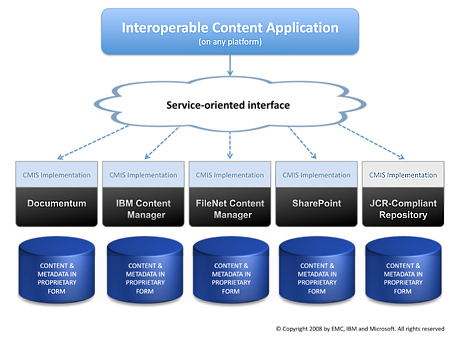
Yesterday I mentioned the Content Management Interoperability Services (CMIS) specification, which has been under development for the last couple of years and has just been submitted to OASIS. So what's this all about?

CMIS provides a common Web Services and Web 2.0 interface into different Enterprise Content Management (ECM) systems, with the aim of providing better interoperability and aid the creation of composite applications. I'm a fan of the ATOM Publishing Protocol and I'm pleased that the CMIS REST specification builds on the ATOM model. This diagram will give you the basic idea of what this is all about:

The vendors who are making noise around the standard included Alfresco, EMC, IBM, Microsoft, OpenText, Oracle and SAP - in itself an interesting reflection of the diversity in the ECM space these days!

There isn't a lot of really detailed analysis of the CMIS announcement yet, but in his typical style EMC's Chuck Hollis gives us four reasons why we shouldn't dismiss the importance of this standard:

  1. It Solves A Real And Growing Problem;
  2. Right Vendors Are Backing It
  3. The Developers Will Want It
  4. Sooner Or Later, This Problem Is Going To Have To Get Solved

Over on the Oracle blogs, Billy Cripe comments, with cautious optimism says:

"What I don't buy (just yet) is that this proposed standard is all that was missing to allow customers to keep their content just where it is and usher in a new and glorious era of enterprise mashups. The standard provides the common baseline of access/retrieval/interaction with unstructured content and its metadata across the participating ECM systems. You can bet the vendors will start here and differentiate on top.

But just the fact that we're all starting here is a very good step in the right direction. Keep in mind that, right now, this is a .5 draft specification so we will see maturation as time goes on and folks sign on."

(BTW See his original post for links to more commentary from around the Web)

Obviously there are still are a lot of details to digest and we need to see all the different vendors actually implement the standard such that it meets the goals of interoperability, but I think the inclusion of a Web 2.0-oriented approach in the specification gives CMIS a good chance of broader adoption. Overall it sounds like if you're in the market for ECM, you better start thinking about adding CMIS to your wants list!

Friday, 12 September 2008

Installation versus Implementation

Back in 2006 I attended one of the most useful training courses I've ever attended, on IMA's Accelerated Implementation Methodology. I've spent most of my professional life as a change agent of one form or another and had even picked up a few good methods, tools and frameworks along the way through my MBT. However, AIM has provided what I would call a great change management "pattern" where I can apply the theory and tools I already had.

Cai Kjaer at Optimice thought AIM was so good, he formed an alliance with IMA to use their methodology in Austalia. This morning I was invited by Cai to head IMA's founder, Don Harrison, to talk about AIM. For me at least, this turned out to be a great refresher on why AIM so useful, and also so important.

It has also given me a great way to explain part of what I do as a consultant... basically:

I help organisations to implement information and knowledge work technologies, not install them.

That might sound like an obvious statement - but when I say I don't install, I actually mean something different from what you might think I mean by install. To quote IMA:

"When we analyze project successes and failures we see that project installation and implementation are very different.

A typical project development cycle ends with “GO LIVE” or “CUTOVER”. We call this the installation phase. While it’s a critically important phase of any project, it alone will not lead to full ROI.

Yet many organizations assume completion at the “cutover” point – installation."

So, what I do is implementation, which is:

"more than getting to project launch or “go live” — implementation means meeting all technical, business, and human objectives on time and on budget. "

BTW Don is a Canadian with a great sense of humour. Because of course, if you are involved in organisational change, you need a very good sense of humour...

Up and coming enterprise social computing tools need to plan for enterprise features now

Obviously there is a lot of excitement about Yammer as the enterprise version of Twitter. But in this post, Mike Gotta is discussing the emergence of enterprise microblogging tools and the importance of addressing corporate issues, like security, audit and records management. However, IMHO the same issues apply across a lot of enterprise social computing space:

"These requirements might “ruin the party” about how people foresee microblogging taking off within the enterprise – but better to plan for such features now, and push vendors to deliver those functions, than ignore some basic blocking-and-tackling issues that inhibited rollout of enterprise instant messaging.

These requirements might “ruin the party” about how people foresee microblogging taking off within the enterprise – but better to plan for such features now, and push vendors to deliver those functions, than ignore some basic blocking-and-tackling issues that inhibited rollout of enterprise instant messaging."

This is a serious issue - don't forget that even today some organisations are still debating the value and risks of instant messaging. How do I know? Well, time and time again over the years I've found myself at the front line of educating users and explaining to decision makers why they really are valuable business tools.

Unfortunately, from a technology architecture view, microblogging is not quite the same as instant messaging. Interoperability is the exception with most enterprise instant messaging platforms, but for the generation of new Web 2.0 inspired enterprise microblogging applications, interoperability and extendibility needs to be built in from the ground up. Just don't forget we still need stability and have to meet our compliance and legal responsibilities too. Delivering both, in the immediate term at least, might be a tall order for vendors with legacy code bases and also the new players alike.

Incidentally, I was reading the other day about Content Management Interoperability Services (CIMS) - maybe this is the interface we need to allow interoperability between enterprise social media and enterprise content management?

What do you think?

BTW I can't tell you yet what Yammer is like first hand, unfortunately I've had problems registering my work email address in order to create an account. The Yammer guys are currently looking into it...

Thursday, 11 September 2008

Great and mediocre blogging expectations

Alex's great follow up post about my thoughts on the nature of blogging resulted in a flurry of comments on his post, but the discussion also leaked out into other conversational platforms, including Twitter and even a Yahoo! Groups mailing list. That in itself is a great example of how online conversations flows through different mediums and tools - blog comments are part of that ecosystem, but not the only channel for conversation. And in fact, let's not forget the unmediated conversations going on offline.

But getting back to Alex's points, he says:

"For me these days a blog is little more than a sophisticated, easy-to-use website platform. A place where an individual or a department/function can have their own site quickly and easily. Simplistic that may be, but whether news posts or thought articles, the commenting or conversation aspect of blogging appears to by dying down in many places... Yet blogs without comment aren't necessarily lacking in readership - or even participation. This is where the "intent" aspect of James D's manifesto falls down for me. I don't think conversations necessarily make a blog."

I don't think either that the level of readership or participation (comments or otherwise) at a particular point in time is a reflection of the blogger's "intent". However, the ability to comment on a blog does reflect that the blogger is open to the potential for further conversation. Bearing in mind that most users don't create new content (think of the 1% rule) and aren't twittering, commenting at least provides an option for everyone to participate.

However, this still doesn't take away from Alex's point that the way we are using blogging technology is changing. Actually, Serena's comment appeals strongly to my socio-technical view point:

"Tools are becoming easier to use and adapt to our needs. They are inching towards transparency. We will continue to interact with technology and ourselves in new ways that we do yet not have the perfect words for."

To refine that point a little, I think in some instances blogging tools (and other social computing technologies, like wikis) have actually tapped into what was a previously unmet need for light weight content management and publishing systems. In the past very few organisations provided people with access to the kinds of tools that would allow this, but Web-based tools and open source have certainly worked to remove that barrier (and created products with better usability in the process).

Incidentally, someone also commented to me offline that the issue of defining blogging is again confused by the use of the word as both a verb and noun, similar to the (mis)use of the word wiki.

But none of this is really core to my point.

Overall I don't disagree with any of Alex's observations about the state of blogging. However, fundamentally my point of view is based on the desire to tease out the different use cases for blogging with the objective of understanding it better as a workplace technology. Simply observing change doesn't inform potential users of the outcomes they should expect by following a particular strategy.

Putting this into context, one of my big concerns about social media like blogging is that organisations approach it as a technology that can be simply deployed and will magically result in a positive organisational outcome - typically that might be something around better communication, fostering social capital and maybe even innovation. The reality of course is that despite the ease of deployment and use a blogging platform provides, ultimately it is how you choose to use it that will make the difference. And simply pushing out content won't make staff or customers engage with you. Note that this is of course different if your intent is simply to use a blog to publish or host content.

While clearly the evidence suggests that you can't simply view blogging as the only social media channel, however for me its still the lowest common denominator place for starting a many-to-many conversation. What then interests me further is helping organisations with the gap between the intent and reality of how they go about blogging to start that conversation.

So, If you have a blog and no one is commenting, my general advice is to pursue it with the expectation and intent that one day they will. But if you accept a mediocre approach, then surely you can only except a disappointing response in return?

Wednesday, 10 September 2008

You can't simply *swap* virtual meetings in place of real meetings

Graham ponders the value of virtual meetings based on his own direct experiences versus the stated benefits:

"I wonder whether the value of many virtual meetings is so low as to make them more expensive than face-to-face meetings. I have participated in many teleconference meetings which have been massively protracted by the limitations of the medium. These meetings have then used far more time than a physical meeting would have, but they have also added massively to the lead-time for resolution. In one particular occasion we were working on a technical problem for over three weeks before a face-to-face meeting resolved the problem in under 2 hours."

I think part of the problem is the expectation that you can simply swap any kind of traditional meeting for a virtual meeting, but this simply isn't the case. Its not a replacement, but a different style of communication and collaboration. Typically a mix of technologies, skills and other resources are needed to be successful - including knowing when only face to face will do!

Tuesday, 9 September 2008

Free Mini Knowledge Management Bootcamp - Thursday 18th September

Over the years I've presented at a number of conferences and even ran a series of Knowledge Management master classes in Singapore in 2006 and 2007. As a result I have a whole stack of materials that are just crying out to be shared around information management, knowledge management and also Enterprise 2.0. The only challenge has been finding the right opportunity present them.

Since joining IPP Consulting, my colleague, Brian Bailey, and I have been talking about running some workshops on these topics and as we've recently moved into new offices on Pitt Street, we now have a venue where we can invite a group of people to a workshop... and to cut a long story short, it is with great pleasure I invite you to attend our first workshop, which will be a 2 hour Knowledge Management Bootcamp.

So, why a KM Bootcamp? We know that the first step with starting or refreshing a KM program can be the most difficult and the idea is to give people the chance to have a bit of a mental workout around the topic of Knowledge Management. With that in mind, our ambitious agenda for this workshop is as follows:

  • “Knowledge Management 101” – what it is, what it might be, what it isn’t
  • Knowledge Management Self Assessment – where you think you are now and where you want to be
  • Key Knowledge Management Strategy Concepts – some tools and templates to help plan a KM strategy (building on the self-assessment)
  • Strategy Clinic – hands on development and peer review

When: 9am-11am, Thursday 18th September 2008

Where: L3, 50 Pitt Street, Sydney 2000

RSVPs: Places are limited - please give me a call on 0414 2333711 if you would like to attend.

Saturday, 6 September 2008

Expanded enterprise social software vendor taxonomy

Hat tip to Patti Anklam for pointing to an overview of vendors in the enterprise social software space by CMS Watch's Tony Byrne. This "vendor taxonomy" divides the world of enterprise social software into the following areas:

  • Platform vendors;
  • Social software suites;
  • Wiki and blogging (and forum) software;
  • White-label community services (e.g. Ning, Lithium); and
  • Public networks (e.g. LinkedIn, Facebook).

However, IMHO this taxonomy misses out a set of other important elements in the enterprise social computing stack. I think in part this might be because CMS Watch's definition of enterprise social software is:

"tools for collaboration and networking within and beyond the enterprise."

However, I think underlying this definition is a vendor and content management system focus (as you might expect). To complete the vendor taxonomy I would expand this list to include other enterprise social computing tools and systems that enable it:

  • Chat and microblogging;
  • Presence and Activity (yes, there is an overlap with social networking tools);
  • Metaverses;
  • "Findability"; and
  • Enterprise RSS (the Cinderella of enterprise social computing!).

There are probably more things we could add to this list but fundamentally I think this is part of the problem - an application-centric view of the social software space is a flawed model for a taxonomy - how do we decide what is and what is out? The application-centric view also really only lends itself to a tactical response to enterprise social computing, where as an Enterprise Web 2.0 (or a Web 2.0 Oriented Intranet) architecture approach will eventually provide a much more satisfactory approach in the longer term. In other words, picking a platform vs a suite vs a wiki is only half the story of building a true enterprise social computing environment. This is something I discussed in my Intranet 2.0 workshop and perhaps in another post I will try to provide an expanded taxonomy based on the concepts from that presentation.

Incidentally Mike Gotta has a great post about presence that I thinks adds weight to argument for an architecture view - otherwise we will find ourselves in the uncomfortable position of trying to include unified communications into the enterprise social computing mix when really it should simply augment the Intranet 2.0 infrastructure.

Couple of articles by Matt (and Keith)

Matt Moore has been busy lately, writing articles for KM Review (with Keith De La Rue), about KM for sales, and the The Australian Human Resources Institute, looking at social networking. Both articles can be downloaded from his blog. BTW I'm following Matt's advice here to "Nurture relationships with people over a period of time through small acts of generosity and trust building." :-)

Monday, 1 September 2008

Web 2.0 Executive Bootcamp - 23 September 2008, Sydney

Stephen Collins is co-delivering (with Hinchcliffe and Company’s, Jeff Kelly) the first ever Web 2.0 Executive Bootcamp in the Southern Hemisphere at Web Directions South:

"Web 2.0 Bootcamp leads you through a deep exploration of the latest ideas, business models, trends, and techniques behind Web 2.0 with a special emphasis on proven, actionable methods for creating new online products and services – or transforming existing ones – using a Web 2.0 model."